Theology of History
 |
 |
 |
 |
 |
 |
 |
Egalitarianism - XVIII
Organic Building of the State & Society
Note: Prof. Plinio gave this series of classes in 1957; today in 2026 we see how the egalitarianism in each of the fields he pointed out has increased and come to dominate almost completely. TIAIn view of these principles based on the hierarchical order of the angels and men, how should society and the State be organized?
Let us first consider the State and society in their legal status. Since it is impossible to organize the State and society by conferring power on the most talented and competent men because these persons appear at random and it would be a very instable regime, how should the government of society be configured? How does this configuration manifest itself in the government of society?
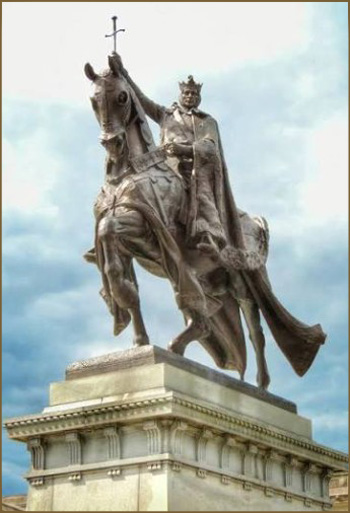
King Louis IX, the happy combination
of wisdom & competence
On the day that psychological tests reach a sufficient level of presumption, they will imagine that they will be able to detect this. They will give five or six tests to a boy – they will show him three black balls on a red background and if he says it is a cat, they will proclaim him a genius; if he says it is four balls he is an idiot. After this, they declare the geniuses detected by psychiatry capable of governing…
But we reject this criterium. Therefore, we have a civil society composed as it has historically been composed: It has a head of State, agents, ministers and officials. So, how is this scheme applied to the State and civil society?
Who should be the King or President
In the State, we cannot systematically apply this scheme. But, if we admit that the elements representing thought constitute cognitive faculties, we can say that those representing the State represent action more and are in line with the operational. And we understand a King well if we imagine him as someone who within his sphere simultaneously holds dominion, virtue and power.
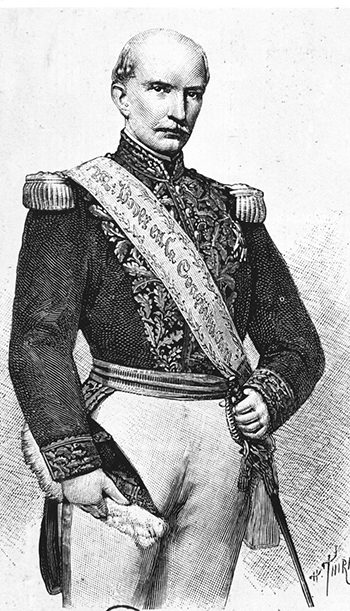
President Gabriel Garcia Moreno,
a model of an organic leader
Second, he must not only have a plan for how to articulate the measures to achieve his objectives, but he must also know how to give the first impulses for them to advance towards those objectives. The first impulse of the governmental machine is clearly given by the Head of State.
Therefore, while this is a principle of domination, it is also a way to maintain power, because at the highest and most eminent level it is against everything that opposes the common good. The President must be the quintessential combatant of the State.
Then, García Moreno has the governors of his provinces who provide for the common good of those particular regions and nothing more. Then, there also many "hidden Garcías" inside the blocs that make up Ecuador. They also, in their smaller spheres, have their functions. They are, therefore, an extension of the person of the President, a miniature of the President present in the various parts of society.
In addition to the governors, the President also has his ministers who deal not with human groups, but with certain types of issues: economy, public education, war, the navy, etc. We could say that governors fall into the angelic category of the Principalities. They take care of large private groups and communities. In contrast, the Angels who oversee matters, who are the Archangels, would properly be the ministers.
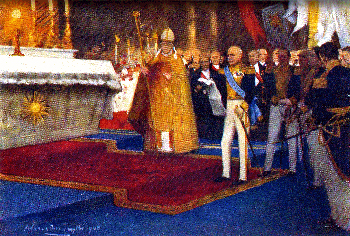
Garcia Moreno, backed by his governors & ministers, consecrates Ecuador to the Sacred Heart
- The King, the one who cares for the common good and prevents everything that harms it;
- His two categories of assistants: the highest-ranking who are the Feudal Lords, responsible for regional groups that make up the Kingdom, and
- A lower category of assistants, who are his ministers in charge of certain categories of affairs.
Summation
After describing the inequality existing in the various kingdoms of Creation, that is, the inequality between Angels, men etc. I stated that, according to St. Thomas, there are some choirs of Angels with a more developed cognitive virtue and other lower choirs with a predominant operative virtue.
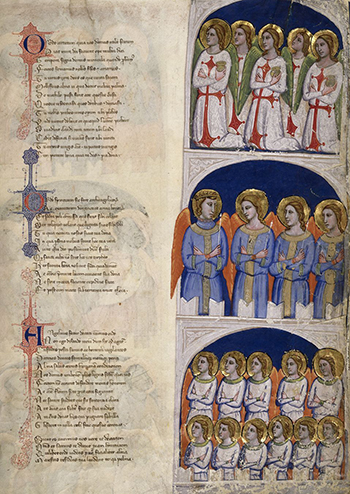
The Choirs of Angels, each with their functions in view of their cognitive & operational virtues
Thus, those who have a preponderant cognitive virtue dominate over those who have a preponderant operative virtue. And they dominate because knowing and ordering are intrinsically superior to operating and doing.
Those who possess operative virtues have a dominance to the degree that operative virtue is greater. This is accompanied by an even greater cognitive virtue, that is, the Angel who possesses a greater operative virtue has, in relation to the one who possesses a lesser operative virtue, a greater dominance.
Next, the intercession of Angels among men comes. St. Thomas shows that, due to the fragility of the human intellect, man cannot even glimpse his destiny and know the truths he needs to know without the help of Angels. The idea of a perfectly self-sufficient man, who directs himself entirely by his own will, who receives no advice from anyone, who is self-sufficient at least within the order of nature – an idea so dear to the French Revolution – is not true.
St. Thomas Aquinas's direct teaching on this subject is: "Due to the weakness of the intellectual light, they [men] are unable to acquire perfect knowledge of those things that concern man unless they are helped by higher spirits, who are the Angels. This is required by divine disposition, so that lower spirits acquire perfection through higher spirits." (Summa contra gentiles, Liber 3, Caput 8)
Therefore, man depends on the Angels to govern his earthly destiny because he needs them. They exercise real authority over him. Therefore, men must obey the Angels.
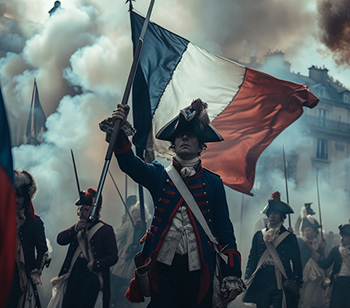
The French Revolution imposed a false equality
& complete independence of man
Posted August 23, 2026



______________________
______________________
 |
 |
 |