Theology of History
 |
 |
 |
 |
 |
 |
 |
Egalitarianism - XIX
The Natural & Proper Government of Men
Note: Prof. Plinio gave this series of classes in 1957; today in 2026 we see how the egalitarianism in each of the fields he pointed out has increased and come to dominate almost completely. TIASince the preeminence of cognitive virtue is what establishes the hierarchy of the entire universe, it follows that those possessing greater cognitive virtue ought, by nature, to govern over those who have lesser or those characterized by operational virtue. There are men created by God to serve other men; their nature is to serve. This is the justification for that picturesque and beautiful institution of the Germanic barbarians known as the "trust," a bond or allegiance.
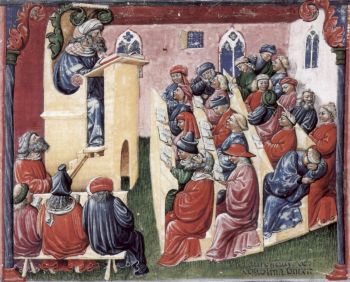
A professor should teach & lead others to knowledge; he is superior to his students
This is very well explained at the theological level. Men of superior intellect were made to be served by others; men of greater operational capacity were made to command those who, in the order of action, have less operational virtue. To deny this is to contradict the natural order of things; to reject this reality is to fall prey to a revolutionary principle.
A curious expression of this revolutionary spirit is to say: "I obey X as long as he has legal authority over me. I obey because doing so does not conflict with my dignity. I understand that a law governs this, but I cannot accept orders from someone who lacks legal authority over me. That would mean acknowledging a personal superiority; it would mean acknowledging an authority based on influence, and that is contrary to my dignity.”
This is an absolutely revolutionary way of seeing things. The truth is that the deepest bond by which one man commands another is not the legal bond. The legal bond is merely the expression of a natural bond. The deepest bond by which one man governs another is the superiority of cognitive virtue over operative virtue, and the superiority of operative virtue.
Napoleon & Charlemagne
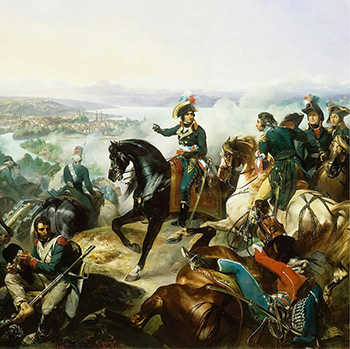
Napoleon, a military leader who commanded effectively; below, Charlemagne, a leader whose peers would follow him anywhere
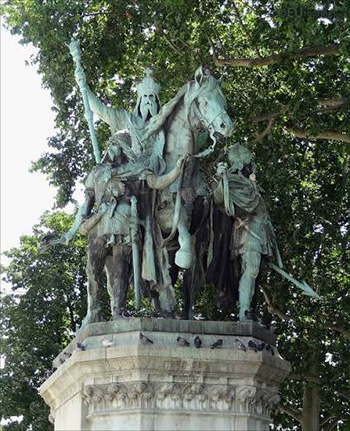
He became Emperor because he exercised command. Because he commanded so effectively – having over those men a natural authority that emanated from a personal superiority – that they acknowledged, this dynamic, which eventually led him to take the imperial title. The title was born from that authority.
This is the true order of things.
Did Charlemagne command his peers simply because he was Emperor? While the imperial title certainly held great weight among his peers, there was something more at play. Had Charlemagne lost the throne, had he fallen into disgrace, those men would have followed him into that disgrace. This stemmed from the vital, natural bond that existed between them.
We are thus aced with the affirmation of a profoundly counter-revolutionary principle. This principle radically rejects the notion of equality among men. …
It is personal superiority that gives rise to true authority. This is a complete inversion of what might be termed the Modern State regime, in which the individual’s standing is defined by protocol – valid only when he wields the authority of the State. Without that authority, his personal value, prestige, personal position, etc. are not recognized, because these are things that fall outside the legal domain.
The jurisdiction of Angels & men over the universe
Next, we see how St. Thomas presents the superiority of man over animals and other beings – noting that while animals lack the cognitive faculties possessed by man, they nonetheless show a certain superiority over other beings.
He also makes an interesting point: It is not assumed that man has entire dominion over the realms of nature beneath him, because he does not. Angels direct the material universe in its broadest and most profound movements, whereas men have only a participation in the direction of the material universe. There is a jurisdiction of Angels over the material universe, just as there is a jurisdiction of men.
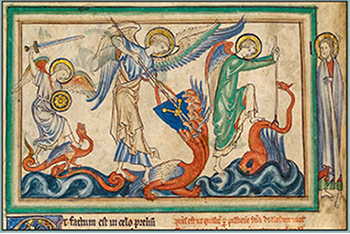
Angels sent by God to carry out his commands in the material universe
St. Thomas's goes on to explain that the word "Angel" means "sent." This is the origin of the name: the Angel is sent by God to govern the lower choirs and use those lower choirs to govern the other degrees of creation. The word "Angel" is used many times in Holy Scripture to designate a man sent to direct and guide other men. For example, the Bishop of the Church of Smyrna and the Bishop of the Church of Laodicea are compared to Angels – not merely figuratively due to a resemblance, but because, as Bishops, they are sent by God to govern those churches and are thus properly called "Angels."
We would have then, regarding all power, strength and greatness flowing from God through a descending chain of causes, each category acting as an "Angel" in relation to the category beneath it. Each category represents God governing and executing Divine Providence in relation to the category below
St. Thomas Aquinas then asks how this natural superiority gives rise to a right to command.
Superiority exists: How does it generate the right to command? How is it possible to deduce, from the fact that one being is superior to another, the right of the former to command the latter? The explanation is as beautiful as it is interesting.
The source of the governance of the universe is the Providence of God, and those who possess superior intellect participate more fully in that Providence. By virtue of this fuller participation, it is fitting that they command those beneath them. To be intelligent is to be capable of ordering. Therefore, those capable of ordering ought to lead those who are capable of executing. Thus, it is intellectual – or cognitive – superiority that generates the right to command.
Further, the dynamic operates in this form: Those who are more active should be assisted by the less active. Since the action of the supporting party is one of subordination, it is clear that the one who holds greater power and receives assistance commands the one providing that assistance.
To be continued
Posted November 13, 2026



______________________
______________________
 |
 |
 |