Personalities
 |
 |
 |
 |
 |
 |
 |
St. Bernard - III
St. Bernard the Peace Maker
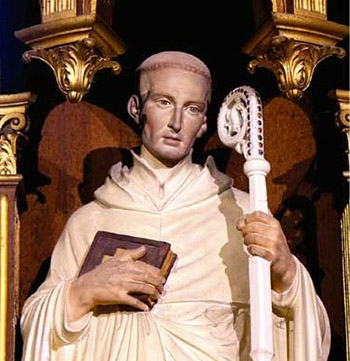
Statue of St. Bernard in his house of birth
in Fontaine-les-Dijon
So the Pope called on the Abbot of Clairvaux to reconcile the two parties, which he did in a short time, for the many miracles he worked disposed the people to hear his words. In 1134 he could address a letter to the citizens of Genoa, congratulating them for standing firm against the schismatics and admonishing them to persevere in the peace. (1)
Reconciliation with Conrad of Staufen & Milan
Before Emperor Lothar III could put his army at the service of the Church in the fight against the anti-pope, he needed to establish peace in his own country. There, Conrad of the Staufen Dynasty, aided by his brother Duke Frederick of Swabia, had contested the election of the legitimate Emperor Lothar and had himself elected King at Nuremberg in 1127. Then, he and his armed men set about trying to win major cities and wrest the Crown by force from Lothar.
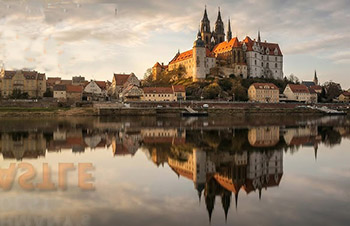
A view from Bamberg
In that same year, St. Bernard was received with great jubilation in Milan, and the city publicly renounced Conrad and were received into the favor of the Pope and the community of the Church. Under his mediation, the Milanese accepted Lothar as their King and lord and recognized him as Roman Emperor.
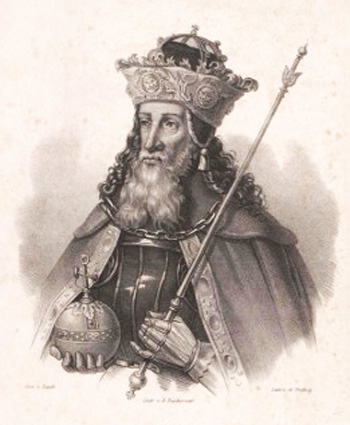
Emperor Lothar II
“You, on the other hand, shall receive due service from them with honor. It is not fitting that your loyal friends, who work for your honor, should lose their esteem in the eyes of others because of your attitude. But they do lose that respect if those who were assured of your clemency and willingness to forgive should find you inexorable.”
This is how the Abbot of Clairvaux brought the needed peace for Lothar be accepted by all Germany as Roman Emperor. With this accomplished, Lothar began preparations for the Italian campaign to defend the rights of Pope Innocent II against the anti-pope.
Bernard’s last work of peace
The last work as mediator came several months before the Abbot’s death in Lorraine. The Abbot was called from his deathbed to end the disastrous war between the Bishop of Metz and the Duke of Lorraine.
The Vita Prima Bernardi records the moving reconciliation:
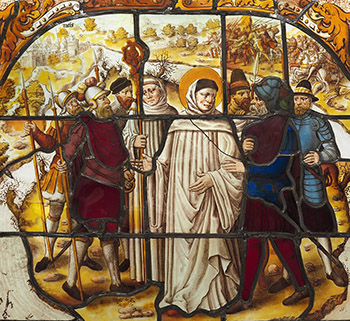
The Abbot of Clairvaux reconciles
the two sparring parties
The townsfolk, in their anger, were preparing to retaliate and the whole province was about to be involved in warfare when Hillin, the venerable Archbishop of Trier, came to Bernard to seek his help. Deploring what had happened and fearing worse to come, he knelt at Bernard’s feet, asking him to come and brave the storm, confident that he could overcome what no one else could.” (3) Bernard’s sickness had in fact diminished in the days before the Archbishops arrival and he commented on the change to a monk: “I am indeed sick unto death. At the present moment however I have been called back from the grave, but not, I feel, for long.” (4)
And, indeed, as often had happened hitherto, Divine Providence saw to it that strength was not lacking for him to undertake the task that of necessity had to be taken. And this time, also, divine aid came to him and he seemed to acquire new vigor to go to Metz for this last task.
When Bernard appeared as mediator at the banks of the Moselle, he found that those who had originally been attacked now had the stronger force and thus had no desire to reconcile. Without even greeting the man of God, they went away and it seemed that all hope of a peaceful settlement was lost. In fact, they left because they feared that the Abbot would manage to dissuade them from doing further harm. Thus the assembly broke up in disorder and great hostility.
But Bernard calmly assured them that peace would come, despite all the difficulties.
When they asked him why he was so sure, he replied: “I had a dream last night, in which I was celebrating a solemn Mass. When I had finished the first prayer I suddenly realized, to my shame that I had left out the Gloria. And so I began it there and then, and I said it through with you to the end. This is a promise that we shall yet sing the Gloria as a song of peace.”
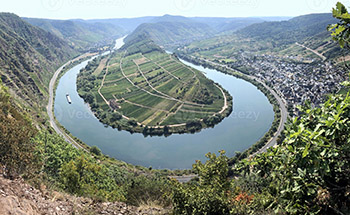
The Moselle River winds around an island where the negotiations took place to escapes the crowds
The huge mass of people who came to be with the Abbot made the negotiations almost impossible. Finally, it was arranged that the leaders of each side should come to an island in the middle of the river. After everything had been arranged according to the proposals of the wise arbiter, each side gave the other its right hand in reconciliation and the kiss of peace.
Cure of a woman suffering convulsions
The Vita relates the miracle that changed the hearts of the two parties thus:
“Of all the miraculous cures that God worked through His servant at that time, the most striking was that of a woman who for eight years was suffering a terrible sickness that left all her limbs in violent trembling and twitching. New difficulties threatening to frustrate the negotiations had just arisen when Divine Providence sent this woman to Bernard. She was in her usual wild convulsions, a sight as pathetic as it was horrible, and she was followed by a large crowd drawn by the spectacle.
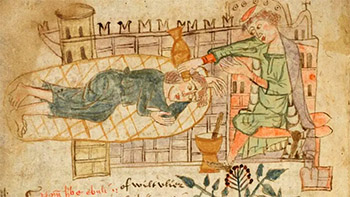
The great miracle: St. Bernard prayed over the woman with convulsions & she was healed
The leaders of the two faction were moved to admit that they must listen to the man whom God so clearly loved: “We must listen to him and do as he says, for we have seen with our own eyes what God has done for him.”
When the Saint returned to the city he urged the Bishop and the people, who were still aching from that old wound, to make peace. And indeed, against their will they were forced to pardon those on whom they had wanted to take a thorough revenge.
The Vita concludes: “This was the beautiful end of your ways, dearest father. This was your last achievement. Your success was so great because your endeavor seemed to be hopeless in the beginning. On this occasion, when peace was without prospects and yet so necessary, your efforts have been richly blessed by Him, Who always honored you in your work, glorified you in His name and His name in you, the King of Glory, your Lord and God.” (5)
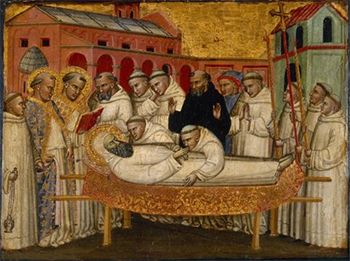
The death of St. Bernard at Clairvaux
on August 20, 1153
His body was laid out in the Lady Chapel at Clairvaux. A multitude came to pay him their last respects. The number of those who came to touch his body with linen cloths for relics never seemed to diminish. On the second day the crush was so great that the people would heed neither the monks nor the Bishops who had come for the burial. Therefore on the third day after Bernard’s death, they buried him very early, fearful that the great crowds jostling to touch him would make this impossible if they delayed until later in the day. (6)
On his breast they placed a relic of St. Jude the Apostle, which had been brought that year from Jerusalem. He had asked that it might be buried with him, trusting that he would be sure to rise from the grave with Our Lord’s Apostle on the last day.
To be continued
- Ep. 129, apud Hugo H However, Saint Bernard The Oracle of the 12th Century, NY: Catholic Book Pub. Co., 1952, pp. 26-27.
- Ibid., pp. 28-29.
- Ibid., pp. 31-32.
- Ibid., p. 32.
- Ibid., pp. 34-36.
- Vita Prima Bernardi, Chap XXXIII, pp. 125-126.
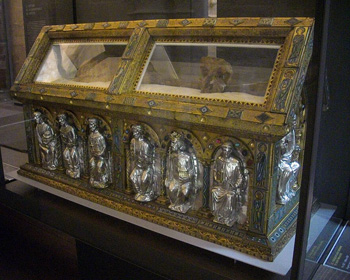
The Saint’s relics were moved to Troyes Cathedral after the
Abbey was destroyed in the French Revolution in 1792



Posted March 18, 2026
______________________
______________________
 Volume I |
 Volume II |
 Volume III |
 Volume IV |
 Volume V |
 Volume VI |
 Volume VII |
 Volume VIII |
 Volume IX |
 Volume X |
 Volume XI |
 Special Edition |