Personalities
 |
 |
 |
 |
 |
 |
 |
St. Bernard & Heretics - I
St. Bernard Combats the Errors
of Peter Abelard
The great Cistercian St. Bernard of Clairvaux (1090-1153) was an Abbot, Confessor and Doctor of the Church. In fact, it seems there is little of import that happened in Christendom in the 12th century where his lively spirit did not play a role.
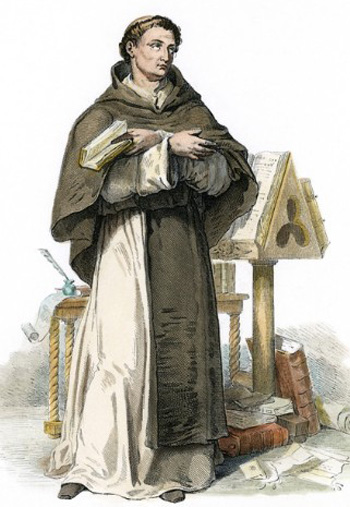 He was a champion of Marian devotion as well as of the Second Crusade, the counselor of Popes and Kings, a peacemaker between Kingdoms, a key player in ending the schism caused by Anti-pope Anacletus II, to mention a few of his actions. Truly this great Cistercian is an inspiring example of the synthesis of the interior life and exterior activity, a type of model idea for today's Catholic who wants to fight for the restoration of the Holy Church and a Catholic society.
In this article, the first in a series, we will present source materials that describe St. Bernard’s fight against the heresies of another famous monk and teacher of his time, Master Peter Abelard, who had established a school at St. Genevieve in Paris. However, serious men found doctrines that did not agree with the teaching of the Church not only in his sermons, but especially in his main work,Theologia Scholarum.
It was the Benedictine Abbot William of St. Thierry who approached St. Bernard to intercede for orthodoxy with these words:
“I am startled that you and others who should speak, keep silent in a quite universal and important affair. … These are not insignificant things in question, but the faith in the Holy Trinity, in God Incarnate, in the Holy Ghost, grace and redemption. Peter Abelard presents his doctrine in pamphlets that spread beyond mountains and oceans. All over the country his new theories are proclaimed and defended, and even at the Roman Curia they are said to have found willing ears. I tell you, if you remain silent, you endanger yourself and the Church.”
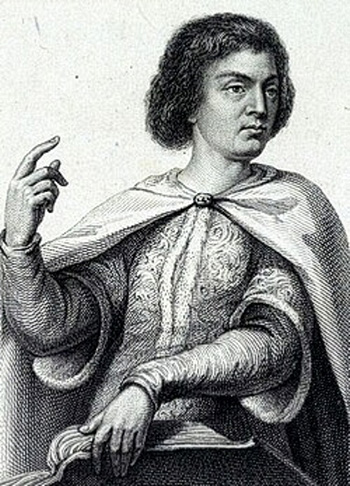 William of St. Thierry sent the Abbot of Clairvaux a copy of Abelard’s Theologia along with his notes on suspect teachings, asking him to judge if his remarks were correct, saying:
“I always apply to you in matters of God and the Roman Church. Abelard fears you. What will he teach if you too close your eyes and he has nobody to fear? I loved him and wanted to continue to do so in the future, God is my witness. But he who attacks our faith can no longer be my friend. A secret admonition will no longer suffice, because he has proclaimed the heresies, publicly.” (Ep. 326) (1)
Bernard agreed to review Abelard’s controversial work and concurred with the opinions of the Abbot of St. Thierry. First he met Abelard in secret and admonished him. His remarks were so convincing that Abelard promised to change his theories. But shortly afterward, in his pride he opened his ears to the praise of bad advisers and trusted again in his own mental powers and dialectics.
Confrontation at the Council of Sens
Peter Abelard went to the Archbishop of Sens, who was sympathetic toward his work, and accused the Abbot of Clairvaux of working secretly against his writings. He asked the Prelate for permission to hold a Council in his Cathedral where he would defend his writings publicly. Abbot Bernard was also summoned to the Council to state what he had against Abelard.
 William of Saint Thierry reported what happened at this famous Council, which was held simultaneously with the feast of Holy Relics of the Cathedral of Sens:
"On the Octave of Pentecost in 1140 the Bishops met with us in Sens to honor the Holy Relics that were to be shown to the faithful in our Cathedral. Among those present were also King Louis of France and the pious Count William of Nevers, the Archbishop of Rheims with some Suffragans (Bishops of his Province), we with our Suffragans, except the Bishops of Paris and Nevers, a great number of Abbots and learned clergymen, and finally, the Abbot of Clairvaux and Master Peter Abelard with his followers.
“The Abbot of Clairvaux presented the Theologia of Master Peter and pointed out the sentences which he had marked as ‘misleading’ and even ‘erroneous.’ Abelard could have denied the authorship of the writings. If he recognized them as his own he had either to prove or to correct the criticized theories. But the Master seemed to distrust his cause and to seek a way out.”
It is certain that Abelard knew well the heavy penalties he was facing should he be convicted of heresy, and suddenly his self-confidence faltered.
After the Council, St. Bernard addressed letters to several Cardinals. He also addressed this explanation to Pope Innocent II:
”Although he was granted free defense and full security as well as self-chosen judges, he did not answer but appealed to you, Most Holy Father, and left the assembly along with his supporters. We do not judge the person of Abelard but we earnestly ask that his doctrines be rejected by Your Authority, because they have led many into fatal error already.” (Ep. 337) (2)
Further, he sent the Pope an entire treatise on Abelard’s heresies (Ep. 190). On July 16, 1141, Pope Innocent II issued a Bull excommunicating Abelard and his followers and imposing perpetual silence on him.
Pope Innocent wrote to the Bishops of France and St. Bernard:
“With grief we learn from your letters and from the enclosed list of heresies, that in our perilous days old heresies revive and new uncatholic doctrines come to the fore in the pernicious teaching of Peter Abelard. We thank God Almighty for the consolation that He gave sons to the fathers of your countries, who, under Our Reign have proved to be loyal shepherds of the Church; who oppose the heresy, and preserve the Bride Pure and Spotless of the Bridegroom who is Christ.
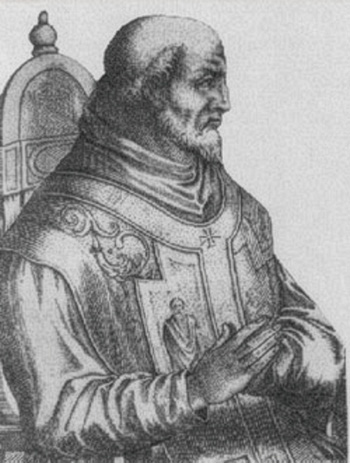 "After conferring with our brethren, the Archbishops and Cardinals, we condemn with apostolic authority the heresies all erroneous doctrines of Peter Abelard, including their author, and enjoin permanent silence on him as a heretic. Everyone adhering to, or defending his heresy shall be excluded from the community of the faithful.” (Ep. 194) ()3)
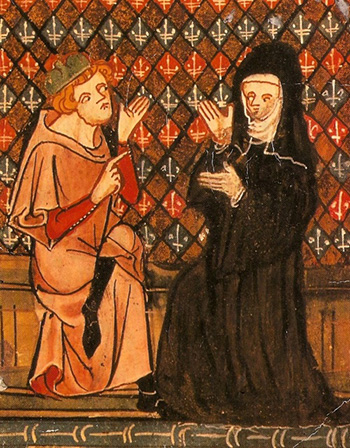
When Abelard died in April of 1142 he was reconciled with God, the Church, and also with St. Bernard, who had always maintained a vigilant caution regarding the controversial monk. This is explained by the unsteady and wavering character of Abelard, and his proud and unrestrained conduct. He continued to write love letters to Heloise even in his confinement at Cluny, and later the priory of St. Marcel near Chalon-sur-Saône.
It is difficult for the modern man – accustomed to the acceptance of unorthodox teachings even from the highest Prelates and Popes of the post-Vatican II Church – to understand the praiseworthy zeal of the Abbot Clairvaux and his contemporaries. They understood heresy as the grave and condemnable offense it is against God and the Holy Church. Thus, they were willing to combat the heresies of their days to preserve the pure and immaculate doctrine of the Catholic Church.
Continued

St. Bernard, truly the oracle of the 12th century
In this article, the first in a series, we will present source materials that describe St. Bernard’s fight against the heresies of another famous monk and teacher of his time, Master Peter Abelard, who had established a school at St. Genevieve in Paris. However, serious men found doctrines that did not agree with the teaching of the Church not only in his sermons, but especially in his main work,Theologia Scholarum.
It was the Benedictine Abbot William of St. Thierry who approached St. Bernard to intercede for orthodoxy with these words:
“I am startled that you and others who should speak, keep silent in a quite universal and important affair. … These are not insignificant things in question, but the faith in the Holy Trinity, in God Incarnate, in the Holy Ghost, grace and redemption. Peter Abelard presents his doctrine in pamphlets that spread beyond mountains and oceans. All over the country his new theories are proclaimed and defended, and even at the Roman Curia they are said to have found willing ears. I tell you, if you remain silent, you endanger yourself and the Church.”
Abelard continues to boldly teach his heresies
“I always apply to you in matters of God and the Roman Church. Abelard fears you. What will he teach if you too close your eyes and he has nobody to fear? I loved him and wanted to continue to do so in the future, God is my witness. But he who attacks our faith can no longer be my friend. A secret admonition will no longer suffice, because he has proclaimed the heresies, publicly.” (Ep. 326) (1)
Bernard agreed to review Abelard’s controversial work and concurred with the opinions of the Abbot of St. Thierry. First he met Abelard in secret and admonished him. His remarks were so convincing that Abelard promised to change his theories. But shortly afterward, in his pride he opened his ears to the praise of bad advisers and trusted again in his own mental powers and dialectics.
Confrontation at the Council of Sens
Peter Abelard went to the Archbishop of Sens, who was sympathetic toward his work, and accused the Abbot of Clairvaux of working secretly against his writings. He asked the Prelate for permission to hold a Council in his Cathedral where he would defend his writings publicly. Abbot Bernard was also summoned to the Council to state what he had against Abelard.
St. Louis IX, Prelates & nobles at the Council of Sens
"On the Octave of Pentecost in 1140 the Bishops met with us in Sens to honor the Holy Relics that were to be shown to the faithful in our Cathedral. Among those present were also King Louis of France and the pious Count William of Nevers, the Archbishop of Rheims with some Suffragans (Bishops of his Province), we with our Suffragans, except the Bishops of Paris and Nevers, a great number of Abbots and learned clergymen, and finally, the Abbot of Clairvaux and Master Peter Abelard with his followers.
“The Abbot of Clairvaux presented the Theologia of Master Peter and pointed out the sentences which he had marked as ‘misleading’ and even ‘erroneous.’ Abelard could have denied the authorship of the writings. If he recognized them as his own he had either to prove or to correct the criticized theories. But the Master seemed to distrust his cause and to seek a way out.”
It is certain that Abelard knew well the heavy penalties he was facing should he be convicted of heresy, and suddenly his self-confidence faltered.
After the Council, St. Bernard addressed letters to several Cardinals. He also addressed this explanation to Pope Innocent II:
”Although he was granted free defense and full security as well as self-chosen judges, he did not answer but appealed to you, Most Holy Father, and left the assembly along with his supporters. We do not judge the person of Abelard but we earnestly ask that his doctrines be rejected by Your Authority, because they have led many into fatal error already.” (Ep. 337) (2)
Further, he sent the Pope an entire treatise on Abelard’s heresies (Ep. 190). On July 16, 1141, Pope Innocent II issued a Bull excommunicating Abelard and his followers and imposing perpetual silence on him.
Pope Innocent wrote to the Bishops of France and St. Bernard:
“With grief we learn from your letters and from the enclosed list of heresies, that in our perilous days old heresies revive and new uncatholic doctrines come to the fore in the pernicious teaching of Peter Abelard. We thank God Almighty for the consolation that He gave sons to the fathers of your countries, who, under Our Reign have proved to be loyal shepherds of the Church; who oppose the heresy, and preserve the Bride Pure and Spotless of the Bridegroom who is Christ.
Pope Innocent II condemns Abelard for heresy
When Abelard died in April of 1142 he was reconciled with God, the Church, and also with St. Bernard, who had always maintained a vigilant caution regarding the controversial monk. This is explained by the unsteady and wavering character of Abelard, and his proud and unrestrained conduct. He continued to write love letters to Heloise even in his confinement at Cluny, and later the priory of St. Marcel near Chalon-sur-Saône.
It is difficult for the modern man – accustomed to the acceptance of unorthodox teachings even from the highest Prelates and Popes of the post-Vatican II Church – to understand the praiseworthy zeal of the Abbot Clairvaux and his contemporaries. They understood heresy as the grave and condemnable offense it is against God and the Holy Church. Thus, they were willing to combat the heresies of their days to preserve the pure and immaculate doctrine of the Catholic Church.
Continued
- Hugo H Hoever, Saint Bernard The Oracle of the 12th Century, NY: Catholic Book Pub. Co., 1952, p. 81.
- Ibid., pp 83-84.
- Ibid., pp. 84-85.
Abelard, bettter known for his love affair with Heloise
than for his heretical teachings


Posted February 13, 2026
______________________
______________________
 Volume I |
 Volume II |
 Volume III |
 Volume IV |
 Volume V |
 Volume VI |
 Volume VII |
 Volume VIII |
 Volume IX |
 Volume X |
 Volume XI |
 Special Edition |