What People are Commenting
 |
 |
 |
 |
 |
 |
 |
Westminster, Translations & Loreto
Traitor Translators

A member of the staff at TIA has done a terrific service on Wednesday the 25. Miss Salwa Bachar has shown how translators can easily become traitors. The example of Our Lady becoming a slave at the Incarnation, but then the protestant term handmaid by traditional Catholics stands out.
Someone or an interested group did not want the word Christ mentioned too many times in the Old Testament, especially the Psalms, and saw to it the name Christ was rendered as 'the anointed.'
The late Solange Hertz wrote in one of her books that Francis Bacon, a Freemason, harnessed 45 translators for the King James perversion of Scripture. For those who know Hebrew and Greek it has many errors.
St. Jerome, pray for us.
Y.H.
______________________
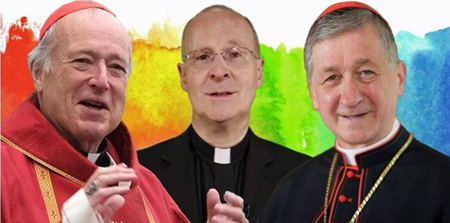
McElroy & Cupich Endorse James Martin
Cardinal Robert McElroy and Cardinal Blase Cupich, archbishops of Washington, D.C. and Chicago, as well as Eduardo Peñalver, the incoming pro-LGBT president of the Jesuit Georgetown University, each sent greetings to attendees of Father James Martin’s Outreach Conference this weekend.
Birds of a feather flock together – but I never dreamed they were be gathering INSIDE the Holy Church.
Click here to read
J.S.
______________________
House of Loreto’s Feast
I hope this message finds you well.
I am writing to you with sincere respect and appreciation for your work. I have been reading your articles regarding the Feast of the Translation of the Holy House of Nazareth to Loreto, (here, here, here, here, here, here and here) and I find the topic very interesting.
However, I have been trying to locate this feast in an older edition of the universal traditional Roman liturgical calendar (prior to the post-Vatican II reforms), and so far, I have not been able to find a clear reference in the general Roman calendar itself.
Would you kindly be able to provide a reference, citation, or link to an official edition of the traditional Roman calendar (with year if possible) where this feast appears as part of the universal liturgical calendar? I would greatly appreciate any guidance that could help me understand this historical point more precisely.
Thank you very much for your time and for any clarification you may be able to offer.
With kind regards,
V.S.
______________________
TIA responds:
Dear V.S.,
We are glad that you found the articles on the Feast of the Translation of the Holy House of Nazareth to Loreto to be helpful. This Feast gave honor to Our Lady and it is a tragedy that the Holy House of Loreto has been so maligned in these times. The Feast, however, was never instituted as a Feast for the Universal Church, such as the Immaculate Conception and the Assumption.
It was approved by the Holy See with a Proper Office and Mass in the year 1699. It was celebrated in some areas and by some Religious Congregations that had special devotion to the Holy House.
This is how many of the Church's feasts began. They were approved and said in certain regions, until the devotion to the feast spread to such an extent that the Holy See promulgated it for the whole Church. The Feast of All Souls Day on November 2 was added to the Church's Universal Calendar in this manner. Unfortunately, the Progressivist liturgical reforms prevented this organic propagation of the Feast of the Holy House to take place.
Dom Guéranger in Volume I of The Liturgical Year explains the status of this feast as follows:
"This Feast is not one of those which is inserted in the universal calendar of the Church, but it is kept at Rome and in the Papal States, in Tuscany, in the Kingdom of Naples, in Spain, in Belgium, in a great many Dioceses in all parts of the Christian world, and by almost all the Religious Orders. It was instituted in thanksgiving for the great favor bestowed on the Western Church, whereby God, to console Christians for the loss of the Holy Sepulcher, miraculously translated into a Catholic land the humble yet ever venerable House in which Mary received the message of the Angel, and where, by the consent of this Holy Virgin, the Word was made flesh and began to dwell among us. It is no unusual thing to meet with Catholics, who are sincerely devoted to their Holy Faith, yet who have never heard of the House of Loreto. It is for their sake that we have resolved to take the opportunity of this Feast to give an exact and concise account of this wonderful event. We take it from the learned and judicious author of the Life of Olier."
If this Feast was listed in a Missal or a Liturgical Calendar, it would be under the section entitled "Masses for Religious Orders," "Masses Celebrated in Some Place" or "Local Feasts." Pre-1955 Missals from Spain, Belgium, Naples or Rome would include this Feast in a section in the end for Supplemental Feasts. The Missale Romanum from 1920 includes this feast listed first in the section Missae pro Aliquibus Locis in the back of the Missal after the Votive Masses. This Missal is only in Latin, so the feast can be found under the Latin title In Translatione Almæ Domus B. Mariæ V. See page 1125 of the PDF version of the Missale Romanum here.
May Our Lady of Loreto bless you and give to you the many graces that flow from devotion to her Holy House.
Cordially,
TIA correspondence desk
Posted July 2, 2026



______________________
The opinions expressed in this section - What People Are Commenting - do not necessarily express those of TIA
______________________
______________________
 |
 |
 |
I read your piece about the Catholic Church in Madrid with the hideous football screens.
Here in London in the overbearingly Novus Ordo Diocese of Westminster, the powers that be are taking their Vatican Two ecumenism drive in a whole new direction, for they have decided to follow the example of the English Protestants in inviting secular entertainment agents to put on shows at Westminster Catholic.
I enclose the link for you to check it out for yourselves.
This is a sad day for the English Catholic Church and the new Archbishop Moth.
LUMINISCENCE in London at the Westminster Cathedral
Apostolic Regards,
J.C., England