Talks with Jan
 |
 |
 |
 |
 |
 |
 |
Choosing, Testing & Keeping Friends
Some years ago, my friend Jan had asked me some questions about the nature of true friendship. To respond, I had recourse to a little known 12th century medieval Cistercian Abbot, St. Aelred of Rievaulx from Yorkshire, who wrote Spiritual Friendship.
 At the end of the article I had promised a follow-up discussing the four stages of friendship: How a friend should be selected, next tested, admitted and then treated henceforth as a friend deserves. Several readers have requested me to continue with that topic, which I intend to do today.
First, let me review the counsels of the English Monk Aelred, who spent the early part of his life at the Scottish Court of King David I (1124-1153), and was raised in the company of the King's sons. It was the great St. Bernard of Clairvaux who ordered the young Cistercian Aelred to digest his notes for novices into books, the first called the Mirror of Charity. It was shortly after his election as Abbot of Rievaulx that he began to pen Spiritual Friendship. His many duties and visitations in his growing monastery that spread to include several others reaching 600 choir monks and lay brothers. That fruitful expansion caused him to set aside this work for two decades until his last years. Accounted the "Bernard of the North," Aelred was named a Saint by the Cistercian order in 1497.
His notion of friendship in many ways was novel for those days. His thinking was that society, even monastic society, depended on relationships, necessary for “the good life” spoken of by the philosophers, in particular Cicero. By loving one’s neighbor properly and with correct intention, one loves God more: “He who dwells in friendship dwells in God, and God in him.” (1)
To properly love those around us according to duty, merit and hierarchical relationship is to produce a kind of love that is a foretaste of Heaven. In effect, he who does this promotes living together as a family of souls, not according to a social contract. It is a difficult concept for the modern mind to conceive since, although friendship has an element of equality, it depends on hierarchical relationships and the responsibilities therein.
It was unthinkable for the medieval man to conceive a society without the feudal relationships of those who serve and those who are served. Every man had a lord, even the King whose power came from God.

 Thus, Aelred paraphrased Scripture with all naturalness, affirming “God is friendship,” (2) for true friendship is the charity that springs directly from God, Who in the overflow of His love created men to share His love by loving each other and Himself. In this way, man gives to Him the external glory that, essentially speaking, was not necessary to Him but that He desired from convenience when He created the angels and man.
As noted in the last article, there are false friendships: There cannot be true friendship with the man given to vice, since he hates his own soul. Friendship for material gain is a false relationship since what is really sought is not the realization of the person's personality but only his material goods.
True friendship in one based on charity, with agreement on things human and divine. Thus, true friendship is possible only between good men, who reject sin and greed.
In Heaven, where all are good, the life of the just will be the life of spiritual friendship. But Aelred believed men can taste that happiness of Heaven here on earth by striving for such ordered relationships here. For him friendship was a necessity, for “to live without friendship is to live like a beast.” (3)
But let us delve deeper into the subject at hand to see how the Saint dealt with the actual work of choosing and keeping friends. I will follow his own style for he wrote his book as a conversation between himself and two friends, Gratian and Walter. I will replace his interlocutors with my good friend Jan as if she were there, asking questions of the medieval monk.
What is necessary for unbroken friendship
Jan: How should a friend should be selected? Usually, I just accept as friends those who are in my family and close circles.
St. Aelred: There should be a criterion for admitting others to the “sweet mystery of friendship,” whose fountain and source is love. For while “there can be love without friendship, friendship without love is impossible.”(3)
Therefore, not all whom we love should be received into friendship, for not all are found worthy of it: “Since a friend is the partner of your soul, to whose spirit you join and link your own and so unite yourself as to wish to become one from two, to whom you commit yourself as to another self, from whom you conceal nothing, from whom you fear nothing, surely you must first choose, then test, and finally admit someone considered right for such a trust. For friendship should be steadfast, and by being unwearied in affection, it should present an image of eternity.” (5)
What does this mean? That friendship cannot be based on tolerance of sin or vice, as so often happens today. Clearly, persons with certain vices should not even be considered for friendship. Thus, those in irregular living situations or those addicted to sin cannot be admitted as friends. For we who are Catholics this is so obvious that it is not necessary to say more on the topic.
One should also take care not to admit into one’s friendship certain types of persons – the irascible (the one given to fits of anger), the fickle, the suspicious and the verbose. Such persons should not be lightly chosen for friendship.
It is difficult for one aroused by the passion of anger [irascible] not to rebel at times against a friend. Hence Scripture says: “Do not make friends with the hot-tempered or walk with a man of violence, lest you learn his ways and bring scandal to your soul.” (Prov 22:24-25) (6)
 The fickle person Aelred compares to one tossed about in every wind and yielding to every word of advice. This person is hardly free from a contagious anxiety. The constantly
suspicious person never shares, for such a one never relaxes. He is constantly seeking out excuses for raising anxieties and restlessness, when what is consonant with friendship is mutual peace and tranquility. The
verbose man who never stops talking is also a source of restlessness and lack of gravity, so necessary for a stable love.(7)
The fickle person Aelred compares to one tossed about in every wind and yielding to every word of advice. This person is hardly free from a contagious anxiety. The constantly
suspicious person never shares, for such a one never relaxes. He is constantly seeking out excuses for raising anxieties and restlessness, when what is consonant with friendship is mutual peace and tranquility. The
verbose man who never stops talking is also a source of restlessness and lack of gravity, so necessary for a stable love.(7)
If you encounter someone with these vices, avoid him, Aelred advises, for until he is cured, he should not be accepted as a friend. Still, if the lives and conduct of those persons are otherwise pleasing, they should be treated with the greatest care because, with the practice of virtue, they can be considered suitable for friendship. (8)
For example, Aelred himself admitted into his friendship an “utterly irascible man,” and although that man often hurt him with his bursts of anger, Aelred never spoke harshly to him or against him. He explained that his good qualities were what earned his friendship, and he preferred to patiently bear with the occasional outbursts that were not made intentionally to hurt him. (9)
Jan: What are the conditions that would cause one to break a friendship?
St. Aelred: The five vices through which friendship is so wounded as to perish are taken from Ecclesiasticus: “Return to a friend if possible, except for slander, attack, arrogance, the betrayal of secrets and the stab in the back” (Eccles 22:22-27). To these he adds one of his own: harm done to anyone for whom we have responsibility.
 Clearly slander extinguishes charity because it harms the reputation. The
arrogant or proud man is often brash in hurling insults and becomes indignant at admonitions; then, he will rarely make the humble apology that can heal a wounded friendship. Nothing tortures the spirit more than abandonment or
attack by a friend.
Clearly slander extinguishes charity because it harms the reputation. The
arrogant or proud man is often brash in hurling insults and becomes indignant at admonitions; then, he will rarely make the humble apology that can heal a wounded friendship. Nothing tortures the spirit more than abandonment or
attack by a friend.
The betrayal of secrets revealed in confidence fills a friendship with bitterness and causes a lack of trust, without which one cannot have a true friendship.
The treacherous blow is the secret detraction [stab in the back]. One who backbites secretly is no better than a serpent that bites in silence, says Solomon (Eccles 10:11) (10)
Aelred adds to these inexcusable vices another: Should a friend harm those whom you love or for whose well-being you are responsible, you should first warn him. If, even after a warning that friend continues to provide the means for ruin and scandal to those others you love, this is cause for dissolving the friendship. “For love should not outweigh religion, loyalty, love of fellow citizens or the safety of the people,” he stated. (11)
Jan: How should someone be tested before being finally admitted as a friend? This is a strange and novel idea for me.
St. Aelred: The need to break off an intimate relationship is painful and unpleasant, Aelred noted. Should it be necessary however, he believed it should be gradual rather than abrupt, giving opportunity always for the friend to correct himself.
However, to avoid this situation, he advised that one carefully choose a potential friend: first, by choosing one who does not differ too much from your character or conflict with your disposition; and then, by making a careful testing before admitting one to intimacy. Four qualities should be tested: loyalty, right intention, discretion and patience.
 For example, loyalty is tested particularly in misfortune. A friend who does not stand by your side in small mishaps will not be there in the great falls. Likewise, one who is trustworthy in something small will be trustworthy in something great. Therefore, to friends still on trial do not entrust your deepest secrets, but at first only trivial ones. If the potential friend proves loyal in these small matters [discretion], do not hesitate to test him in greater secrets, and should he prove loyal, gladly admit him to a friendship.
The intention of one chosen should also be subtly tested, to be certain his aim to be linked with you is not just the hope of gain. Often the rich man has more difficulty finding real friendship than the poor, for friendship with the latter does not incite envy. Aelred told us a test for intention: If someone appears to care less for you than for your possessions and always focuses on what benefit you can confer on him, you might promote someone more worthy than he or not give him what he insinuates or asks. His reaction will allow you to discern his purpose in being close to you. (12)
As for patience, there is no shortage of occasion to test it. Also, it may be necessary to reprove the one you desire as a friend, and sometimes the reproof should be purposely harsh. His response will inform you of his intentions and good will.
Finally, our Abbot warned against the passionate outbursts of love, which outstrips judgment and robs it of the power of discrimination. (13) How many friendships made in haste due to a first and passionate affection can later prove to cause sadness and anxieties. This advice applies also to those seeking spouses.
But I have overextended the article and may be trying the patience of my friend Jan and my readers. So, for the sake of friendship, I will close. Perhaps in another article we could look at the last points of Abbot Aelred, which would be how to treat a friend as he deserves, how true friendships on earth are a foretaste of the friendships in Heaven, and an example of a true friendship, Jonathan and David.
To be continued


St. Aelred of Rievaulx, the 'St. Bernard of the North'
First, let me review the counsels of the English Monk Aelred, who spent the early part of his life at the Scottish Court of King David I (1124-1153), and was raised in the company of the King's sons. It was the great St. Bernard of Clairvaux who ordered the young Cistercian Aelred to digest his notes for novices into books, the first called the Mirror of Charity. It was shortly after his election as Abbot of Rievaulx that he began to pen Spiritual Friendship. His many duties and visitations in his growing monastery that spread to include several others reaching 600 choir monks and lay brothers. That fruitful expansion caused him to set aside this work for two decades until his last years. Accounted the "Bernard of the North," Aelred was named a Saint by the Cistercian order in 1497.
His notion of friendship in many ways was novel for those days. His thinking was that society, even monastic society, depended on relationships, necessary for “the good life” spoken of by the philosophers, in particular Cicero. By loving one’s neighbor properly and with correct intention, one loves God more: “He who dwells in friendship dwells in God, and God in him.” (1)
To properly love those around us according to duty, merit and hierarchical relationship is to produce a kind of love that is a foretaste of Heaven. In effect, he who does this promotes living together as a family of souls, not according to a social contract. It is a difficult concept for the modern mind to conceive since, although friendship has an element of equality, it depends on hierarchical relationships and the responsibilities therein.
It was unthinkable for the medieval man to conceive a society without the feudal relationships of those who serve and those who are served. Every man had a lord, even the King whose power came from God.
The ruins of the Abbey of Rievaulx, destroyed by the Protestants; below, how it would have looked in the 12th century under St. Aelred's rule
As noted in the last article, there are false friendships: There cannot be true friendship with the man given to vice, since he hates his own soul. Friendship for material gain is a false relationship since what is really sought is not the realization of the person's personality but only his material goods.
True friendship in one based on charity, with agreement on things human and divine. Thus, true friendship is possible only between good men, who reject sin and greed.
In Heaven, where all are good, the life of the just will be the life of spiritual friendship. But Aelred believed men can taste that happiness of Heaven here on earth by striving for such ordered relationships here. For him friendship was a necessity, for “to live without friendship is to live like a beast.” (3)
But let us delve deeper into the subject at hand to see how the Saint dealt with the actual work of choosing and keeping friends. I will follow his own style for he wrote his book as a conversation between himself and two friends, Gratian and Walter. I will replace his interlocutors with my good friend Jan as if she were there, asking questions of the medieval monk.
What is necessary for unbroken friendship
Jan: How should a friend should be selected? Usually, I just accept as friends those who are in my family and close circles.
St. Aelred: There should be a criterion for admitting others to the “sweet mystery of friendship,” whose fountain and source is love. For while “there can be love without friendship, friendship without love is impossible.”(3)
Therefore, not all whom we love should be received into friendship, for not all are found worthy of it: “Since a friend is the partner of your soul, to whose spirit you join and link your own and so unite yourself as to wish to become one from two, to whom you commit yourself as to another self, from whom you conceal nothing, from whom you fear nothing, surely you must first choose, then test, and finally admit someone considered right for such a trust. For friendship should be steadfast, and by being unwearied in affection, it should present an image of eternity.” (5)
What does this mean? That friendship cannot be based on tolerance of sin or vice, as so often happens today. Clearly, persons with certain vices should not even be considered for friendship. Thus, those in irregular living situations or those addicted to sin cannot be admitted as friends. For we who are Catholics this is so obvious that it is not necessary to say more on the topic.
One should also take care not to admit into one’s friendship certain types of persons – the irascible (the one given to fits of anger), the fickle, the suspicious and the verbose. Such persons should not be lightly chosen for friendship.
It is difficult for one aroused by the passion of anger [irascible] not to rebel at times against a friend. Hence Scripture says: “Do not make friends with the hot-tempered or walk with a man of violence, lest you learn his ways and bring scandal to your soul.” (Prov 22:24-25) (6)
Be careful of the man prone to anger and outbursts
If you encounter someone with these vices, avoid him, Aelred advises, for until he is cured, he should not be accepted as a friend. Still, if the lives and conduct of those persons are otherwise pleasing, they should be treated with the greatest care because, with the practice of virtue, they can be considered suitable for friendship. (8)
For example, Aelred himself admitted into his friendship an “utterly irascible man,” and although that man often hurt him with his bursts of anger, Aelred never spoke harshly to him or against him. He explained that his good qualities were what earned his friendship, and he preferred to patiently bear with the occasional outbursts that were not made intentionally to hurt him. (9)
Jan: What are the conditions that would cause one to break a friendship?
St. Aelred: The five vices through which friendship is so wounded as to perish are taken from Ecclesiasticus: “Return to a friend if possible, except for slander, attack, arrogance, the betrayal of secrets and the stab in the back” (Eccles 22:22-27). To these he adds one of his own: harm done to anyone for whom we have responsibility.
Revealing secrets breaks the trust necessary for true friendship
The betrayal of secrets revealed in confidence fills a friendship with bitterness and causes a lack of trust, without which one cannot have a true friendship.
The treacherous blow is the secret detraction [stab in the back]. One who backbites secretly is no better than a serpent that bites in silence, says Solomon (Eccles 10:11) (10)
Aelred adds to these inexcusable vices another: Should a friend harm those whom you love or for whose well-being you are responsible, you should first warn him. If, even after a warning that friend continues to provide the means for ruin and scandal to those others you love, this is cause for dissolving the friendship. “For love should not outweigh religion, loyalty, love of fellow citizens or the safety of the people,” he stated. (11)
Jan: How should someone be tested before being finally admitted as a friend? This is a strange and novel idea for me.
St. Aelred: The need to break off an intimate relationship is painful and unpleasant, Aelred noted. Should it be necessary however, he believed it should be gradual rather than abrupt, giving opportunity always for the friend to correct himself.
However, to avoid this situation, he advised that one carefully choose a potential friend: first, by choosing one who does not differ too much from your character or conflict with your disposition; and then, by making a careful testing before admitting one to intimacy. Four qualities should be tested: loyalty, right intention, discretion and patience.
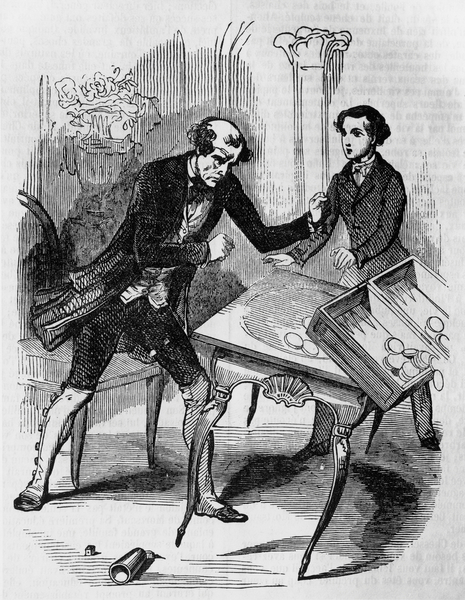
The impatient man can be violent when tested
The intention of one chosen should also be subtly tested, to be certain his aim to be linked with you is not just the hope of gain. Often the rich man has more difficulty finding real friendship than the poor, for friendship with the latter does not incite envy. Aelred told us a test for intention: If someone appears to care less for you than for your possessions and always focuses on what benefit you can confer on him, you might promote someone more worthy than he or not give him what he insinuates or asks. His reaction will allow you to discern his purpose in being close to you. (12)
As for patience, there is no shortage of occasion to test it. Also, it may be necessary to reprove the one you desire as a friend, and sometimes the reproof should be purposely harsh. His response will inform you of his intentions and good will.
Finally, our Abbot warned against the passionate outbursts of love, which outstrips judgment and robs it of the power of discrimination. (13) How many friendships made in haste due to a first and passionate affection can later prove to cause sadness and anxieties. This advice applies also to those seeking spouses.
But I have overextended the article and may be trying the patience of my friend Jan and my readers. So, for the sake of friendship, I will close. Perhaps in another article we could look at the last points of Abbot Aelred, which would be how to treat a friend as he deserves, how true friendships on earth are a foretaste of the friendships in Heaven, and an example of a true friendship, Jonathan and David.
To be continued
Rievaulx Abbey, where all dwelt together in friendship
under Abbot Aelred


Posted April 24, 2026
______________________
______________________

|