Theology of History
 |
 |
 |
 |
 |
 |
 |
St. Hildegard’s Lauds to Our Lady
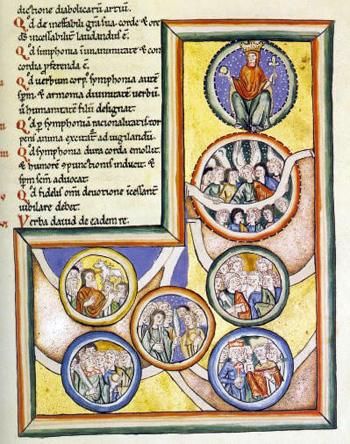
The Choirs of the Blessed, from Hildegard of Bingen’s Scivias (c. 1185)
Our Lady sits enthroned above the choirs of Angels. In the next layer of the Saint's vision of the Church Triumphant, the Virgin rules in radiant majesty over the Apostles, Patriarchs and Prophets, Virgins, Confessors and Martyrs.
Clearly St Hildegard saw Our Lady as Queen of the Universe, playing a powerful role in the sanctification of men. She is the link between the Created and the Uncreated, above the Angels and mediatrix between God and man. She viewed the Virgin as the bridge between Heaven and earth.
Our Lady’s role in salvation is clear to St. Hildgarde: “Because a woman instituted death; The luminous Virgin has abolished it,” she wrote in her Antiphon 7.
Hymns to Our Lady
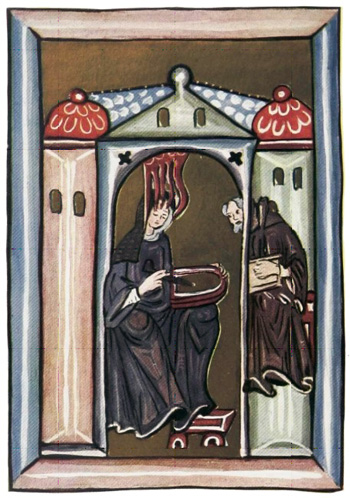
Flames symbolize the lights of the Holy Spirit inspiring the Saint’s words (c. 1185)
In the first hymn below, St. Hildegard refers to Our Lady as a “branch and mediatrix” in the a hymn that includes mediatrix in the very title. If you click on the title link, you can hear the music and find sheet music.
Alleluia! O Virga Mediatrix
Alleluia Verse for the Virgin (R 473vb)
Alleluja! O virga mediatrix, sancta viscera tua mortem superaverunt et venter tuus omnes creaturas, illuminavit in pulchro flore de suavissima integritate clausi pudoris tui orto.
Alleluia! O branch and mediatrix,
Thy sacred flesh has conquered death,
Thy womb all creatures illumined in beauty’s bloom
From that exquisite purity of thy enclosèd modesty sprung forth
O Splendidissima Gemma
Psalm Antiphon for the Virgin (R 466vb)
In this second hymn she implicitly recognizes Our Lady’s role as Mediatrix saying that she is the matter “whereby the Word exhales all virtues.”
O splendidissima gemma et serenum decus soliqui tibi infusus est,
fons saliens de corde Patris, quod est unicum Verbum suum,
per quod creavit mundi primam materiam, quam Eva turbavit.
Hoc Verbum effabricavit tibi Pater hominem et ob hoc es tu
illa lucida materia per quam hoc ipsum Verbum exspiravit omnes virtutes,
ut eduxit in prima materia omnes creaturas.
O most splendid gem, this fair grace like the sun which pours through thee,
Is as a spring leaping from the Father's heart, For this is His only Word, and from this The prime matter of the world was created, which Eve disturbed.
So the Word was fashioned, by the Father, into human form,
And therefore you are that one shining matter, whereby the Word exhales all virtues, drawing out all creatures from prime matter.
Ave Maria, O Auctrix Vite
Responsory for the Virgin (D 153r-v, R 467v)
In the third hymn she is called the “authoress of life.” By bearing the Son of God, she crushed the serpent’s head, thus playing the role God desired to give her in the redemption of man.
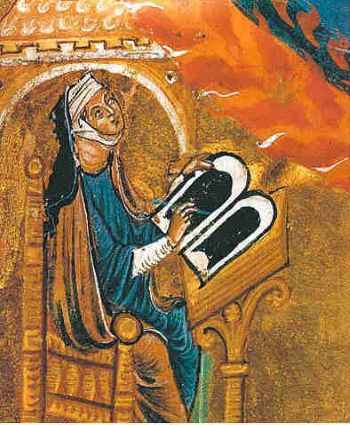
St. Hildegard honors Our Lady's role in the redemption
Que mortem conturbasti et serpentem contrivisti,
Ad quem se Eva erexit erecta cervice cum sufflatu superbie.
Hunc conculcasti dum de celo Filium Dei genuisti,
R. Quem inspiravit Spiritus Dei.
V. O dulcissima atque amantissima mater, salve,
que natum tuum de celo missum mundo edidisti:
R. quem inspiravit Spiritus Dei.
Gloria Patri et Filio et Spiritui sancto.
R. quem inspiravit Spiritus Dei.
R. Hail Mary, O authoress of life, rebuilding up salvation’s health,
For death you have disturbed,
That serpent crushed to whom Eve raised herself,
Her neck outstretched with puffed-up pride.
That serpent’s head you ground to dust when heaven’s Son of God you bore,
R. On whom has breathed God’s Spirit.
V. O sweet and most beloved mother, hail!
Your Son from heaven sent you gave unto the world:
R. On whom has breathed God’s Spirit.
Glory be to the Father and to the Son and to the Holy Spirit.
R. On him has breathed God’s Spirit.
O Clarissima Mater
Responsory for the Virgin (R 467vb-468ra)
The last hymn hails her as the “Mother of a holy medicine” who pours her ointments through her Son on fallen mankind.
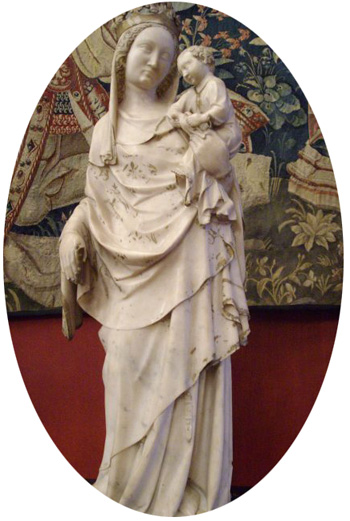
Virgin and the Child Jesus, Cluny monastery
tu unguenta per sanctum Filium tuum infudisti
in plangentia vulnera mortis,
que Eva edificavit in tormenta animarum.
Tu destruxisti mortem, edificando vitam.
R. Ora pro nobis ad tuum natum, stella maris, Maria.
V. O vivificum instrumentum et letum ornamentum et dulcedo omnium deliciarum, que in te non deficient.
O radiant bright, mother of a holy medicine,
Your ointments through your holy Son you’ve poured
Upon the plangent wounds of death,
By Eve constructed as torture chambers of the soul.
This death you have destroyed by building life.
R. Pray for us to your child, O sea star Mary.
V. O instrument of life and joyful ornament, and sweetener of all delights, that in you will not fail.
Many more similar hymns can be found at the International Society of Hildegard von Bingen Studies. The Latin for these hymns was collated from the transcription of Beverly Lomer and the edition of Barbara Newman; translated by Nathaniel M. Campbell.
Posted December 10, 2025



______________________
______________________
 |
 |
 |