Catholic Virtues
 |
 |
 |
 |
 |
 |
 |
Gravitas, a Virtue - II
Vigilance in Our Amusements
In my last article I wrote about foolishness and seriousness. I established an opposition between them, but only briefly; I mostly discussed the importance of seriousness rather than go into detail about the “habitual jocularity” that is opposed to it.
I would like to expound a bit on that latter subject, speaking more broadly about amusements and how they can be ordered or disordered.
 In this barbarous modern era of ours where people’s “hobbies” amount to cheering on celebrity ball players, watching blasphemous cinema, and laboring day and night to “level up” in video games, it is hard for many to find a Catholic balance in things. How are they to act when the work of the day is done?
Obviously, one should not take the position of Luther, to end up drunk every night and in a wheelbarrow. But neither should he adopt a Calvinist approach, to shrivel up into some insensate stranger to joy. There is a place for recreation – ordered and within proper limits.
Indeed, various means of recreation, as parts of Catholic Civilization, we are called by God not only to have, but to perfect, as noted here in a TIA commentary: “When God made Adam from the dust of the earth, He gave him the mission to reign over all Creation. This mission implies that man should use his capacities and skills to make Creation more perfect. ... It is implicitly understood that if man does not execute… works of art, God is deprived of the glory He wants to receive from them.
 “What applies to art, which is one branch of culture, also applies to the whole tree. Man should strive to perfect culture. So, we defend that man should constantly aim to improve his way of dressing, behaving, eating, etc. with the goal of making them achieve the perfection they should have according to God’s plan.”
Recreation is a part of culture, and is a legitimate need for most, due to the limits of our bodies. It is like the oil that helps keep the various parts of a battle tank operational. Without this oil, it may move slowly or not at all; the cannon may not fire. So in many cases a good oiling is warranted.
But if the tank is immersed in this oil, there is the chance it may cease to function. I say chance because the danger of the pleasures is, as Atila Guimarães points out, “not their intensity, but rather their lacking any reference to the metaphysical. The intensity of the pleasure is dangerous when it deviates from the metaphysical. There are good pleasures and, when their intensity follows the line of the metaphysical, they lead to God.” (1)
An intense pleasure leading to God
Can one really seek Him through such a means?
In his article on man’s thirst for the absolute, Prof. Plinio uses the example of the perfect beer to show how the Catholic finds the absolute even in his everyday life: “The draft beer, like everything that exists, is a kind of sketch, or outline, of a more perfect ideal being.
 "Being perfect means two things: first, having no defects; and second, taking its qualities to the maximum of what it can be. I will not have understood beer if I cannot imagine the perfect beer. After imagining it, this imperfect draft makes me understand a possible being that is the joy of my life. …
“In the draft beer, I see the possibility of it being much more than it is, and this possibility speaks to me of God. … It is clear that the specific end of the religious sphere is to lead man to God, who is the Absolute. But it is possible to go to other partial absolutes also through the temporal world, because God is the author of both worlds.” That is to say, the good pleasures of this world can aid in ascent to God as reflections of Him. One can imagine the hobbies of a Catholic as the means to find some aspect of Him inactivity, such as, for example, sketching a portrait or playing chess.
I am reminded of a very rich saying of Bl. Gregory Lopez: “The eyes of a wise man are always fixed on Christ, who is his head; and the soul that is touched with the love of God is like a needle that is touched with the loadstone, which always points to the North. Thus, in whatever place a truly spiritual man is, and in whatever he is employed, his eyes and his heart are always fixed on Jesus Christ.” (2) [Emphasis added]
 So, we have another legitimate purpose for recreation: not only to rest the Catholic, but to enrich him and Christian Civilization. In the Middle Ages we find that every facet of culture tended towards perfection. That is, each people in Europe was gradually building and reshaping everything until it matched its ideal, desired from eternity by God.
Architectural feats, such as the Guild Halls of Belgium, easily illustrate this, as do the pastimes of the era – for they too stand as shining ornaments of that grand time and place. Each not only reflected God in its own little way, but instilled in Catholics admirable virtues: peace, calm, serenity, even strength! They rested the Catholic, and they ordered him.
TIA has published many articles on how Catholic peoples have enriched themselves and the Church at large (e.g. here, here and here). They are worth reading!
Meanwhile, this response by the TIA correspondence desk provides practical advice and examples for Catholics searching for healthy pastimes.
The need for vigilance
What true Catholic does not await the Reign of Mary? Sadly, it must also be “the reign of vigilance or it will be ephemeral like a dream," as Dr. Plinio warns.
St. Louis de Montfort foresaw that God would raise the greatest saints to establish His Mother’s Reign. And yet we are warned by Prof. Plinio: “Evil will continually be reborn. The anti-Christian conspiracy will continue to exist in the Reign of Mary, and if the good do not have their eyes continually fastened on it, it will conquer.”
 How will they disestablish, brick by brick, the earthly kingdom of the Queen of Heaven? Perhaps – if not too predictably – the same way they subverted, usurped, destroyed before: through pleasure.
After those first triumphant Crusades, medieval man, no longer seriously threatened by the Mohammedan forces, and seduced by the luxurious world of the East, diverted himself, but too much, too deeply, in a bad way.
Atila Guimarães observes a key mechanism of the Revolution: “Through agents strategically placed, the Revolution started to exaggerate man’s appetite for earthly pleasures. … The constant parties, tournaments, and festivals created an atmosphere of enjoying life that replaced the former serious ambience. With this, the appetite for pleasure was transformed into an unbalanced eagerness to enjoy life.”
The result of this? “The constant quest for delightful experiences and indulgence of the senses necessarily produced softness and sensuality.” (Ibid).
Parallel to this, the Secret Forces influenced the nobility to become overly proud of themselves and their supposedly “new” learning that came from the pagan Roman and Greek world. Having planted these little seeds of pride and sensuality, the Devil had all that he needed. The dynamism of the vices was unleashed, and in a relatively short period the good medieval order changed.
Contemplating the ocean, Dr. Marian Horvat notes that the first fall in the passions leads to all the others: “It is first step taken toward a vice, the first time one steals or lies or commits an act of impurity, that has the greatest resonance. It echoes in each of the following steps, repeating and multiplying itself. … All the potential of the zenith is already contained in the first movement [of sin].” That is, the final consequences of the Revolution – Communism, Tribalism, Satanism etc. – were contained in those first failings of medieval man.
 Had medieval man been vigilant, none of this may have happened. But the Devil was and is cunning. How easy it is to let a vice through the door, then a mortal sin, then another, when they are presented so charmingly in the seductive dress of amusement.
It is legitimate, when weary, to divert ourselves for a time with hobbies and fun so that we are better able to bear the cross tomorrow. When an amusement would have us forget the cross, however, we must forget the amusement instead.
It is interesting to note that it is the cross that was missing in Disney World. The marvelous, charm and wonder of that magical world so alien to the generally protestant spirit of Americans captivated visitors. But in that realm of sunny make-believe, some element of the cross, essential to the Catholic spirit, was missing. It was almost inevitable that Disney would end the way it did: open to every revolutionary exaggeration (Feminism and the occult) and even degradations (promotion of the LGBT agenda).
From another point of view, to the degree that our amusements strengthen in us virtue, they are good. In the measure that they are insufficient in this, or act in an opposing way, they must be watched against or denied.
Vigilance is key, always and everywhere. Even when we amuse ourselves, we must never forget the Enemy who seeks to undo us and Christian Civilization. These points must all be kept in mind when we wish to relax or select a hobby.
Continued

I would like to expound a bit on that latter subject, speaking more broadly about amusements and how they can be ordered or disordered.
Video gaming, hardly a recreation to rest the soul
Obviously, one should not take the position of Luther, to end up drunk every night and in a wheelbarrow. But neither should he adopt a Calvinist approach, to shrivel up into some insensate stranger to joy. There is a place for recreation – ordered and within proper limits.
Indeed, various means of recreation, as parts of Catholic Civilization, we are called by God not only to have, but to perfect, as noted here in a TIA commentary: “When God made Adam from the dust of the earth, He gave him the mission to reign over all Creation. This mission implies that man should use his capacities and skills to make Creation more perfect. ... It is implicitly understood that if man does not execute… works of art, God is deprived of the glory He wants to receive from them.
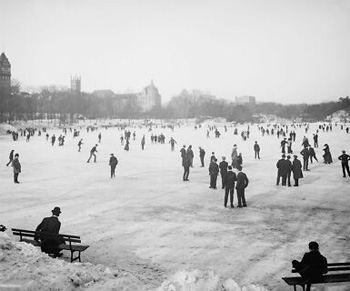
Skating in days past, vigorous
but with a pervading calmness
Recreation is a part of culture, and is a legitimate need for most, due to the limits of our bodies. It is like the oil that helps keep the various parts of a battle tank operational. Without this oil, it may move slowly or not at all; the cannon may not fire. So in many cases a good oiling is warranted.
But if the tank is immersed in this oil, there is the chance it may cease to function. I say chance because the danger of the pleasures is, as Atila Guimarães points out, “not their intensity, but rather their lacking any reference to the metaphysical. The intensity of the pleasure is dangerous when it deviates from the metaphysical. There are good pleasures and, when their intensity follows the line of the metaphysical, they lead to God.” (1)
An intense pleasure leading to God
Can one really seek Him through such a means?
In his article on man’s thirst for the absolute, Prof. Plinio uses the example of the perfect beer to show how the Catholic finds the absolute even in his everyday life: “The draft beer, like everything that exists, is a kind of sketch, or outline, of a more perfect ideal being.
The quest for the perfect beer
has become an art in Belgium
“In the draft beer, I see the possibility of it being much more than it is, and this possibility speaks to me of God. … It is clear that the specific end of the religious sphere is to lead man to God, who is the Absolute. But it is possible to go to other partial absolutes also through the temporal world, because God is the author of both worlds.” That is to say, the good pleasures of this world can aid in ascent to God as reflections of Him. One can imagine the hobbies of a Catholic as the means to find some aspect of Him inactivity, such as, for example, sketching a portrait or playing chess.
I am reminded of a very rich saying of Bl. Gregory Lopez: “The eyes of a wise man are always fixed on Christ, who is his head; and the soul that is touched with the love of God is like a needle that is touched with the loadstone, which always points to the North. Thus, in whatever place a truly spiritual man is, and in whatever he is employed, his eyes and his heart are always fixed on Jesus Christ.” (2) [Emphasis added]
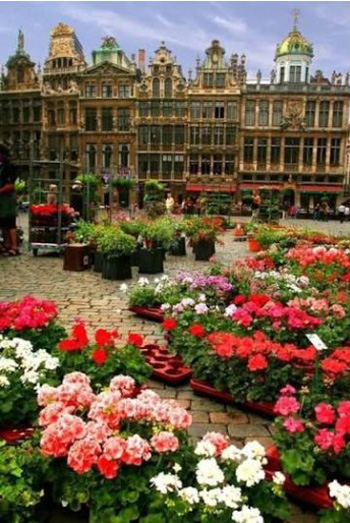
A flower market in Brussels Grand Place with its marvelous medieval square Guild Halls
Architectural feats, such as the Guild Halls of Belgium, easily illustrate this, as do the pastimes of the era – for they too stand as shining ornaments of that grand time and place. Each not only reflected God in its own little way, but instilled in Catholics admirable virtues: peace, calm, serenity, even strength! They rested the Catholic, and they ordered him.
TIA has published many articles on how Catholic peoples have enriched themselves and the Church at large (e.g. here, here and here). They are worth reading!
Meanwhile, this response by the TIA correspondence desk provides practical advice and examples for Catholics searching for healthy pastimes.
The need for vigilance
What true Catholic does not await the Reign of Mary? Sadly, it must also be “the reign of vigilance or it will be ephemeral like a dream," as Dr. Plinio warns.
St. Louis de Montfort foresaw that God would raise the greatest saints to establish His Mother’s Reign. And yet we are warned by Prof. Plinio: “Evil will continually be reborn. The anti-Christian conspiracy will continue to exist in the Reign of Mary, and if the good do not have their eyes continually fastened on it, it will conquer.”
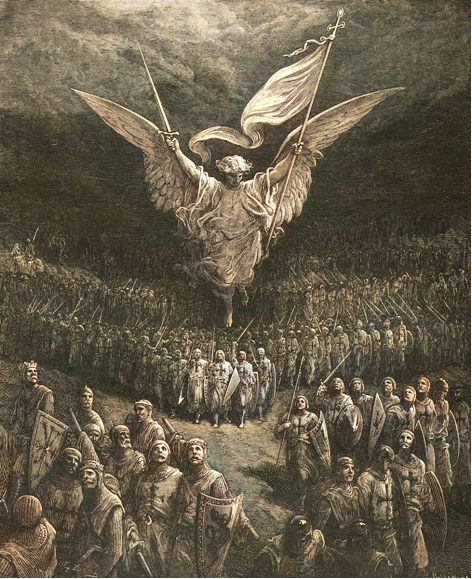
A great vigilance will be needed
to sustain the Reign of Mary
After those first triumphant Crusades, medieval man, no longer seriously threatened by the Mohammedan forces, and seduced by the luxurious world of the East, diverted himself, but too much, too deeply, in a bad way.
Atila Guimarães observes a key mechanism of the Revolution: “Through agents strategically placed, the Revolution started to exaggerate man’s appetite for earthly pleasures. … The constant parties, tournaments, and festivals created an atmosphere of enjoying life that replaced the former serious ambience. With this, the appetite for pleasure was transformed into an unbalanced eagerness to enjoy life.”
The result of this? “The constant quest for delightful experiences and indulgence of the senses necessarily produced softness and sensuality.” (Ibid).
Parallel to this, the Secret Forces influenced the nobility to become overly proud of themselves and their supposedly “new” learning that came from the pagan Roman and Greek world. Having planted these little seeds of pride and sensuality, the Devil had all that he needed. The dynamism of the vices was unleashed, and in a relatively short period the good medieval order changed.
Contemplating the ocean, Dr. Marian Horvat notes that the first fall in the passions leads to all the others: “It is first step taken toward a vice, the first time one steals or lies or commits an act of impurity, that has the greatest resonance. It echoes in each of the following steps, repeating and multiplying itself. … All the potential of the zenith is already contained in the first movement [of sin].” That is, the final consequences of the Revolution – Communism, Tribalism, Satanism etc. – were contained in those first failings of medieval man.
The first Disney World invited to the marvelous, but without the cross
It is legitimate, when weary, to divert ourselves for a time with hobbies and fun so that we are better able to bear the cross tomorrow. When an amusement would have us forget the cross, however, we must forget the amusement instead.
It is interesting to note that it is the cross that was missing in Disney World. The marvelous, charm and wonder of that magical world so alien to the generally protestant spirit of Americans captivated visitors. But in that realm of sunny make-believe, some element of the cross, essential to the Catholic spirit, was missing. It was almost inevitable that Disney would end the way it did: open to every revolutionary exaggeration (Feminism and the occult) and even degradations (promotion of the LGBT agenda).
From another point of view, to the degree that our amusements strengthen in us virtue, they are good. In the measure that they are insufficient in this, or act in an opposing way, they must be watched against or denied.
Vigilance is key, always and everywhere. Even when we amuse ourselves, we must never forget the Enemy who seeks to undo us and Christian Civilization. These points must all be kept in mind when we wish to relax or select a hobby.
Continued
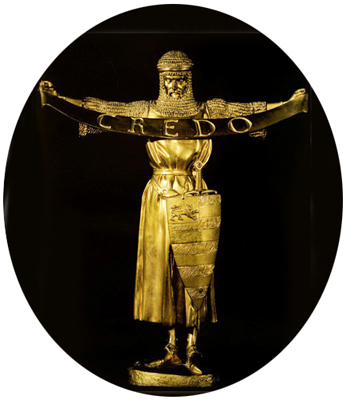
A symbol of knightly vigilance
- 1See Atila Guimarães, The Human Process, Tradition in Action, 2020, p. 31
- See Francisco de Losa, The Life of Gregory Lopez, John Eyre, 1841, p. 101.


Posted May 13, 2026
______________________
______________________
 Volume I |
 Volume II |
 Volume III |
 Volume IV |
 Volume V |
 Volume VI |
 Volume VII |
 Volume VIII |
 Volume IX |
 Volume X |
 Volume XI |
 Special Edition |