International Affairs
 |
 |
 |
 |
 |
 |
 |
Asia Arms up as Tensions Reach Boiling Point
- Asian military spending is surging due to regional tensions and doubts about U.S. protection.
- China leads with a $320 billion budget, driving its military modernization and ambitions.
- Japan has dramatically increased defense spending, overturning decades of pacifist policy.
- The U.S. is explicitly urging allies to spend more to counter an imminent Chinese threat.
- This arms race risks unintended conflict and marks a volatile new chapter in Asian security.
According to recent data from the Stockholm International Peace Research Institute (SIPRI), the figures are staggering. China remains the region’s undisputed top spender, with its military budget growing by more than 20 percent between 2020 and 2024 to approximately $320 billion. This massive investment is driven by Beijing’s armed forces modernization and its expansive territorial ambitions. Following behind, India has increased its spending by 8 percent to $84 billion, prioritizing technological advancement amid border disputes. Saudi Arabia, facing Middle East instability, boosted its budget by 13 percent to $79 billion.
A dramatic shift in the pacifist powerhouse

Prof. Ken Jimbo, advisor to Japan’s Foreign & Defense Policy: ‘We need to stand on our two feet’
This momentous change underscores a dramatic rethink in Tokyo, prompted by China’s military buildup, North Korea’s missile tests, and anxieties over the reliability of the U.S. alliance. As international security expert Ken Jimbo noted, the U.S. no longer views it “necessary to engage in a conflict where it doesn’t really affect the U.S. national interests directly.” Japan’s goal, officials say, is to show it is a serious ally and to “stand on our own feet as much as possible.”
The American push for allied spending
The call for Asian nations to open their wallets has been echoed loudly from Washington. At last year’s Shangri-La Dialogue in Singapore, U.S. Defense Secretary Pete Hegseth issued a direct warning. “It has to be clear to all that Beijing is credibly preparing to potentially use military force to alter the balance of power in the Indo-Pacific,” he said. “The threat China poses is real, and it could be imminent.”
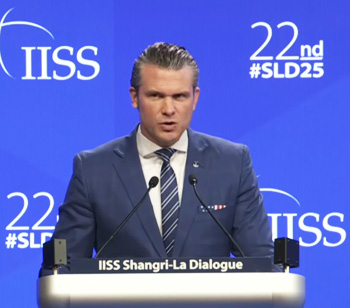
Pete Hegseth at the Shangri-La Dialogue in 2025: ‘US allies must assume the expenses of their defense’
Other hotspots are following suit. Taiwan, under constant pressure from Beijing, increased its military spending by 37 percent over five years, focusing on asymmetric defense capabilities. South Korea’s President, Lee Jae Myung, announced an 8.2 percent boost to the defense budget for this year, stating, “To ensure peace and prosperity for the Republic of Korea, we must not depend on anyone else but strengthen our own power.”
The rapid militarization is not without its critics or risks. Some, like University of Tokyo professor Atsushi Ishida, warn of a dangerous arms race and the potential for unintended conflict through accidents or miscalculation. “This possibility of unwanted, tragic conflict is something I find deeply concerning,” Ishida said, reminding citizens that they ultimately “pay the unbearable costs and the sacrifices.”
What we are witnessing is more than just a series of budget hikes; it is the fragmentation of a regional order. Nations are making sober calculations that they can no longer afford to outsource their security. This historic pivot toward self-reliance signals a new, more volatile chapter in Asian geopolitics, where the price of peace is being measured in billions, and the sound of diplomacy is being drowned out by the roar of jet engines and the silent ascent of new missiles. The world’s economic center of gravity is now also its most heavily armed, a combination that history suggests requires careful handling.
Read other articles by Cassie B. here
Posted January 12, 2026



______________________
______________________
 The Return of the Muslim Threat |
 War, Just War |
 In the Wake of the Crusades |
 The Universal Republic Blessed by the Conciliar Popes |
 Vade Mecum on the Errors of Nazism |
 Curious Affinities Between the Thinking of John Paul II and Marxism |